
Everybody knows this man
Every family has one. An uncle, a neighbour, a friend of your father's.
For fifteen years he was the one everyone pointed to. The business was moving. The cars were new. He paid school fees for half the family and nobody ever saw him worry about money.
Then something happened. A contract fell through. A partner cheated him. The market turned, or the government changed a rule, or a shipment never arrived.
And within two years he had nothing.
Not less. Nothing. The same man who had carried an entire family was now the one being carried.
What is striking is not that his business failed. Businesses fail everywhere in the world. What is striking is that fifteen good years left him with no landing. Every franc that came in went back into the business, or into the life around the business. When the business stopped, the money stopped the same week.
He did not have a second floor.
The rule of two floors
Think of your money as a building.
The first floor is what you earn — your salary, your business, your trade. Almost everybody lives there, and it is held up by one thing: you.
The second floor is money that earns without you. It does not get sick, it does not get fired, and it does not lose a contract.
Most people spend their whole lives building the first floor higher and never build the second one at all. So the higher they climb, the further there is to fall.
The question is not how much you earn. It is this: if your income stopped tomorrow, what would you land on?
Three people, one starting line
Three people start working the same year. All of them are 25. None of them is unusual.
Person A takes a steady job. He is good at it and he enjoys it. He has no interest in running a business and never will. He starts on 300,000 francs a month.
Person B is lucky. A multinational hires him on 800,000 francs a month, and his career there will carry him to 2.5 million.
Person C starts a business. Some years are hard. Several are very good.
Now watch what each of them does with the extra.
Person A keeps it boring
From his very first month, he sends 50,000 francs into a portfolio. That is all.
Over thirty-five years his salary climbs from 300,000 to 1.2 million a month. He never raises the 50,000. Not once.
By 60 he has put in 21 million francs of his own money. The portfolio is worth about 130 million, and it pays him roughly 919,000 francs a month, for life, without touching the capital.
His final salary was 1.2 million. His pension will replace only part of that, the way pensions do. The portfolio covers most of what is missing, and he retires on something close to the life he actually had.
Had he saved nothing, he would be where most retired people end up: living on a pension built for a smaller life than the one he grew used to, cutting back a little more each year.
Person B buys his freedom instead of a bigger life
His salary doubles, then nearly doubles again. He does not let his lifestyle grow with it.
He lives on half and invests the other half — 400,000 francs a month at the start, more every year as the salary rises.
By 45 he has put in about 179 million francs. The portfolio is worth about 399 million, and it pays him roughly 2.8 million francs a month.
His salary at that point is 2.5 million. His portfolio now pays him more than his job does.
He is 45 years old. He can keep working because he wants to, or stop because he can. That is the real prize for a high earner — not a bigger house at 45, but the option to walk away with thirty good years still in front of him.
Person C has no pension at all
Nobody deducts anything for his retirement. No employer will send him a franc when he stops. Whatever he has at the end is whatever he built himself.
He also cannot copy Person B. His money belongs in his business, where it works harder than any portfolio would. Pulling it out to invest would be a mistake, and nobody is asking him to.
So he leaves his capital alone and takes only the extra — 100,000 francs a month that used to leak away on things he would not remember a year later.
By 60 he has put in 42 million francs. The portfolio is worth about 260 million and pays him roughly 1.84 million francs a month. That is his pension, and he built it out of leaks.
But the number that matters most comes much earlier. At 45, twenty years in, the portfolio is already worth about 63 million and pays 444,000 francs a month.
So go back to the uncle. If Person C's business collapses at 45 — the contract gone, the partner gone, the market turned — he does not land on the ground. He lands on 444,000 francs a month, arriving every month whether or not he ever works again.
It will not feel like wealth. It is rent, food, school fees and dignity. It is the difference between starting again and being finished.
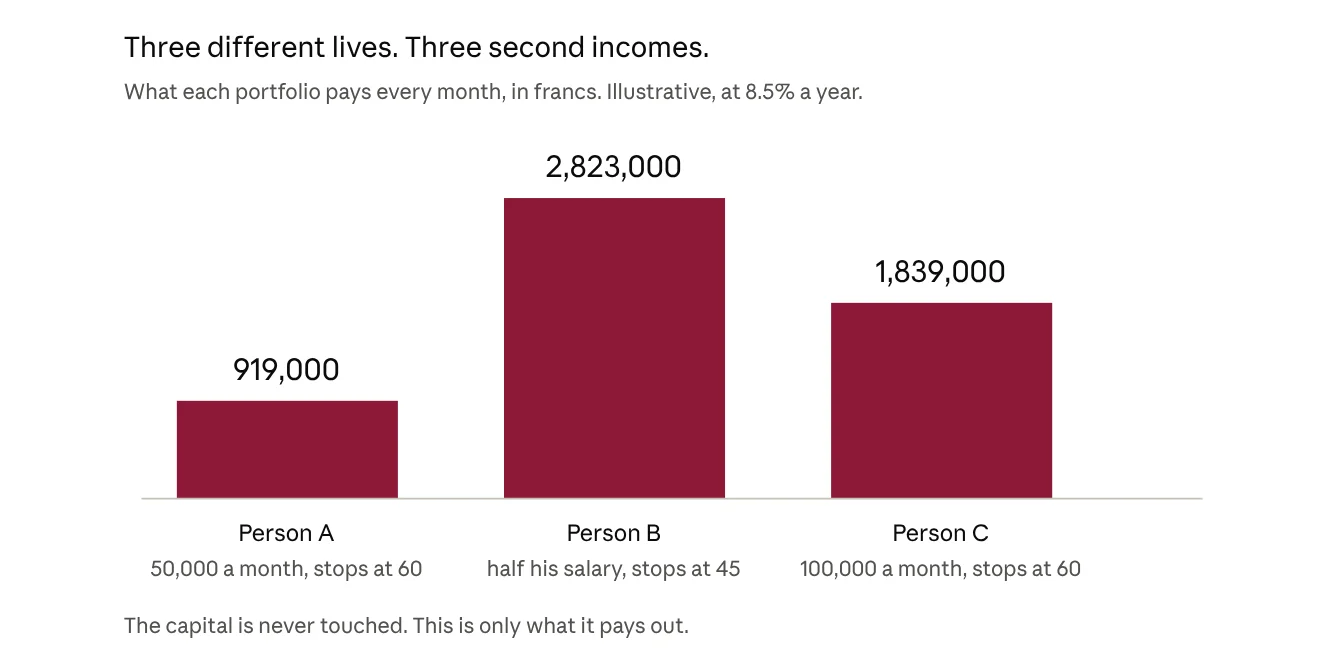
Three completely different lives. Not one of them did anything clever. Each simply sent a part of what he earned somewhere it could keep working without him.
Where the money actually comes from
Almost nobody has spare money. Everybody has leaks.
So do not go looking for a large amount. Go looking for the small things that are already leaving and buying you nothing:
• A subscription you forgot you were paying for
• The newer phone when the current one works
• The car upgrade that was really about what people would say
• One outing a month, out of four
Find 50,000 francs in there. If you can find 100,000, better — but 50,000 is enough to start, and over fifteen years it still builds a portfolio paying about 128,000 francs a month.
Then set it to leave your account automatically, on the day you are paid, before you have a chance to spend it. Money you never see is money you never miss.
And this is the point worth sitting with: the best time to build the second floor is while you are still standing comfortably on the first one. Nobody can start a fifteen-year plan in the month their business collapses. By then the only question left is how far down the ground is.
The uncle had fifteen good years to do this. So do you, probably, right now.