
Where this started
Run our valuation models across the seven companies listed on the BVMAC and the result is uncomfortable. Only one, SEMC, sits anywhere near what we think it is worth. Every other name trades above fair value, several of them by more than half.
That is a strange thing to find on a small exchange. It raised a question we could not answer by looking at today's prices: was the market always like this, or did something happen along the way? If prices ran up after listing, then at least the early buyers were rewarded and the problem is simply that we are late. If prices never ran up at all, the explanation lies somewhere else entirely.
So we went back to the beginning of each company's life on the market and read the document it listed with.
Two we could not follow
SEMC and SAFACAM came to the market a generation ago, in the Douala Stock Exchange era. We could not obtain their original offer documents, so we cannot say how either was priced and we have left them out of what follows. It is worth noting that SEMC is the one name on the board trading close to fair value today.
That leaves six listings we could trace: SOCAPALM, BGFI Holding, BANGE, SCG-Ré, La Régionale, and RENAPROV, which has completed its offer but has not yet started trading.
Of those six, two look to us as though they were priced properly. Four do not.
The four that were not
BANGE, SCG-Ré, La Régionale and RENAPROV were priced in four different years by four different arrangers, and they went wrong in the same three ways.
They priced the balance sheet instead of the business. Every one of the four was valued by applying a multiple to shareholders' equity, or by dividing equity by the number of shares. None used an earnings multiple as its main method.
That matters more than it sounds. Book value tells you what a company owns today; it says nothing about whether the company can earn a decent return on it. A bank worth exactly its book value is a bank expected to earn exactly its cost of capital — so anything above book is a bet on returns above that, and the size of the bet is measurable before you subscribe. Sell a bank at twice book and it has to earn roughly twice its cost of capital, perhaps 24%, for the buyer to come out level.
BANGE is the plainest example. Its entire valuation is one line of arithmetic: regulatory own funds of 41.2 billion divided by 200,000 shares, giving 206,220 FCFA. No earnings multiple, no discounted cash flows, no comparables, nothing to check the answer against. And 28% of that equity base is risk provisions — money set aside precisely because loans are expected to go bad, counted at full value as something investors should pay for. Strip them out and book value was 146,510, so the offer was in truth 1.41 times book. BANGE earns a 5.9% return on equity. At that rate, paying book value is paying about seventeen times earnings for a bank that is barely growing.
They chose the method that gave the biggest number. SCG-Ré's document is the most carefully written of the four, and it shows the problem most clearly. The reinsurer ran three valuations and averaged them. But two of the three are the same method — a price-to-book multiple applied twice to an identical equity base, once using listed companies and once using past transactions. Averaging all three therefore hands that single method two-thirds of the weight.
The third method is the interesting one. The document itself states that for a regulated financial company, la méthode recommandée is the excess-capital approach. It then runs that method, gets 15,692 FCFA a share, and sells at 20,000 — 27% above its own stated best practice.
The comparables were stretched too. Nine of the ten listed companies cited are insurers rather than reinsurers, in Morocco, Egypt, South Africa and Kenya, markets with nothing like Gabon's liquidity. Every transaction cited is from 2015 to 2017, five to seven years stale, and most were purchases of controlling stakes — which carry a control premium that has no business being applied to a minority share in an illiquid listing.
They priced the business plan, not the business. This is where La Régionale sits, and it is the clearest case in the whole study, because the bank published exactly what it expected to achieve.
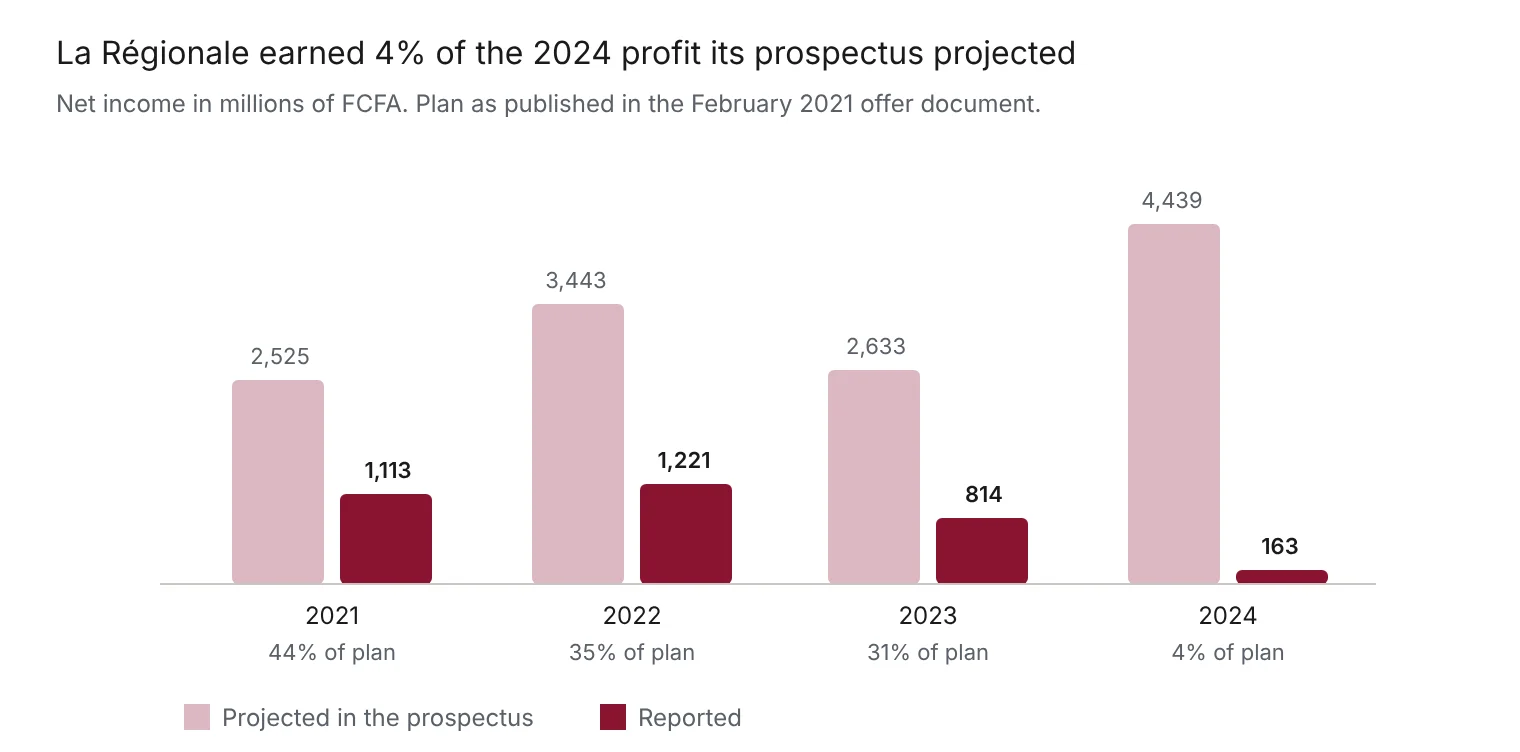
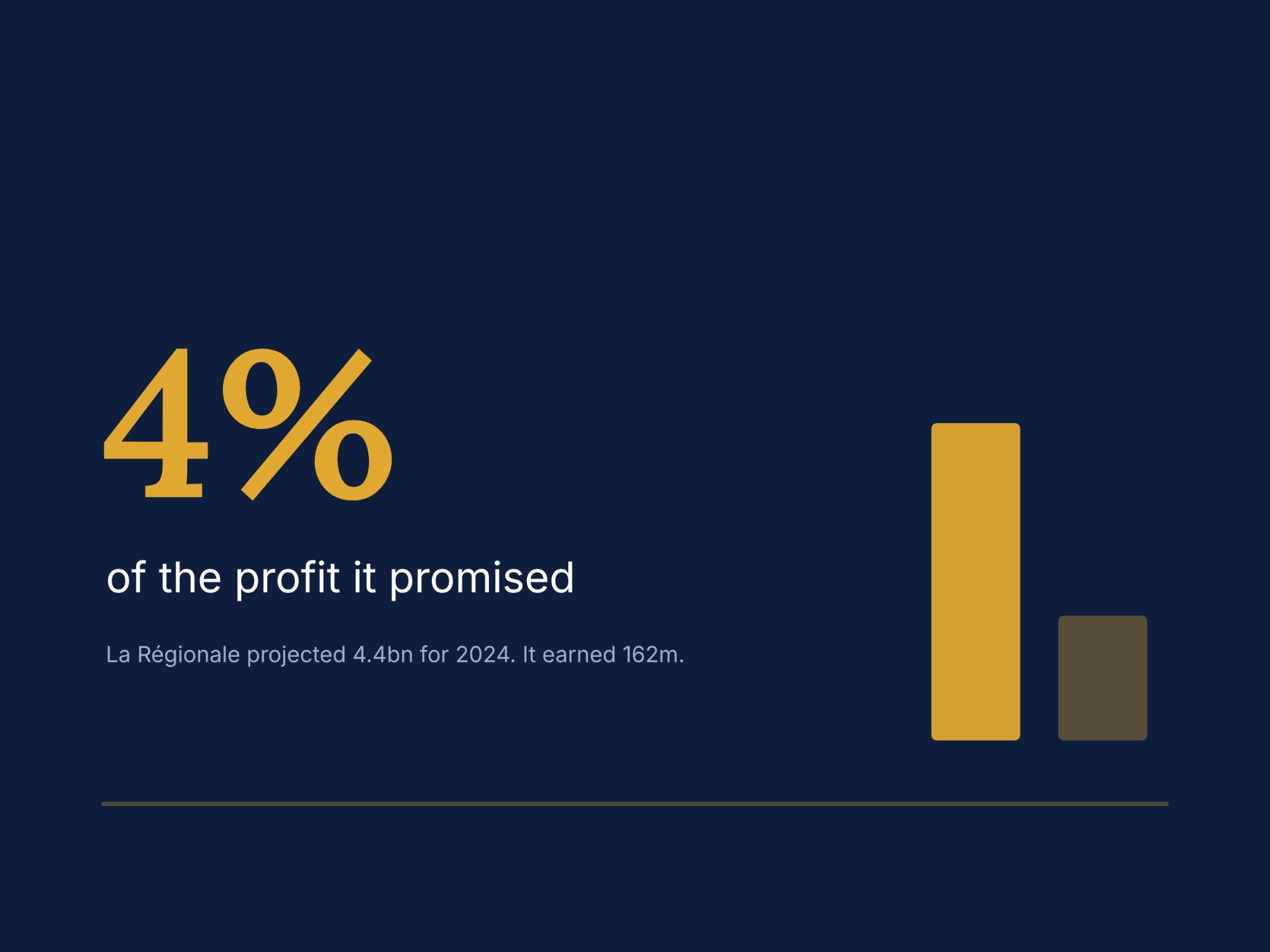
The prospectus projected profits rising to 4.4 billion FCFA by 2024. The bank earned 162 million that year, a return on equity of 1.3%. The same document set 2025 targets of 208 billion in assets, 165 billion in deposits and 150 billion in loans, and said in terms that ces perspectives permettent de justifier une valorisation de FCFA 42 milliards. The bank reported roughly 81, 51 and 40 billion.
At 42,000 FCFA a share the offer valued La Régionale at about 38 times its 2021 earnings and 2.2 times its post-money book. Investors put in 8.23 billion for 19.6% of a company whose book was 18.9 billion — paying 8.23 billion for 3.70 billion of book value, and handing 4.53 billion to the existing shareholders on the first day.
And they borrowed their multiples from each other. La Régionale's 2.1 times book came from the offer documents of three BRVM banks: Coris, NSIA and Oragroup. RENAPROV, listing five years later, took the same 2.1 times — and its beta — straight from La Régionale, and says so: "correspondant au multiple d'entrée de La Régionale Bank." By then La Régionale had spent five years below its issue price.
Follow that number back and it never reaches a market. Four companies, nine years, two currency zones, and not one price struck between a real buyer and a real seller anywhere in the chain. RENAPROV's own document also divides by two different share counts in its two methods, 900,000 in one and 500,000 in the other, then averages the results. Put both on the same basis and the price comes out at 15,576 FCFA rather than 21,000.
What that does to a market
An offer priced this way does not just disappoint whoever buys it. It changes who buys it at all.
Anyone capable of reading a set of accounts can run these numbers in an afternoon, and institutions do. When the arithmetic says a bank must earn 24% to justify its price and the bank earns 6%, the professional investor does not subscribe — and does not put clients into it either. What remains is retail money, placement obligations, and related parties. Subscription falls short of target, the free float ends up small, and a small float does something quietly damaging: it holds the quoted price up, because there is never enough stock on offer to test it.
That is the market we have. On 27 August 2026, across La Régionale, BANGE and SCG-Ré, 7,609 shares were offered for sale and one traded. The prices on the board are real in the sense that they are printed. They are not real in the sense that you could sell at them.
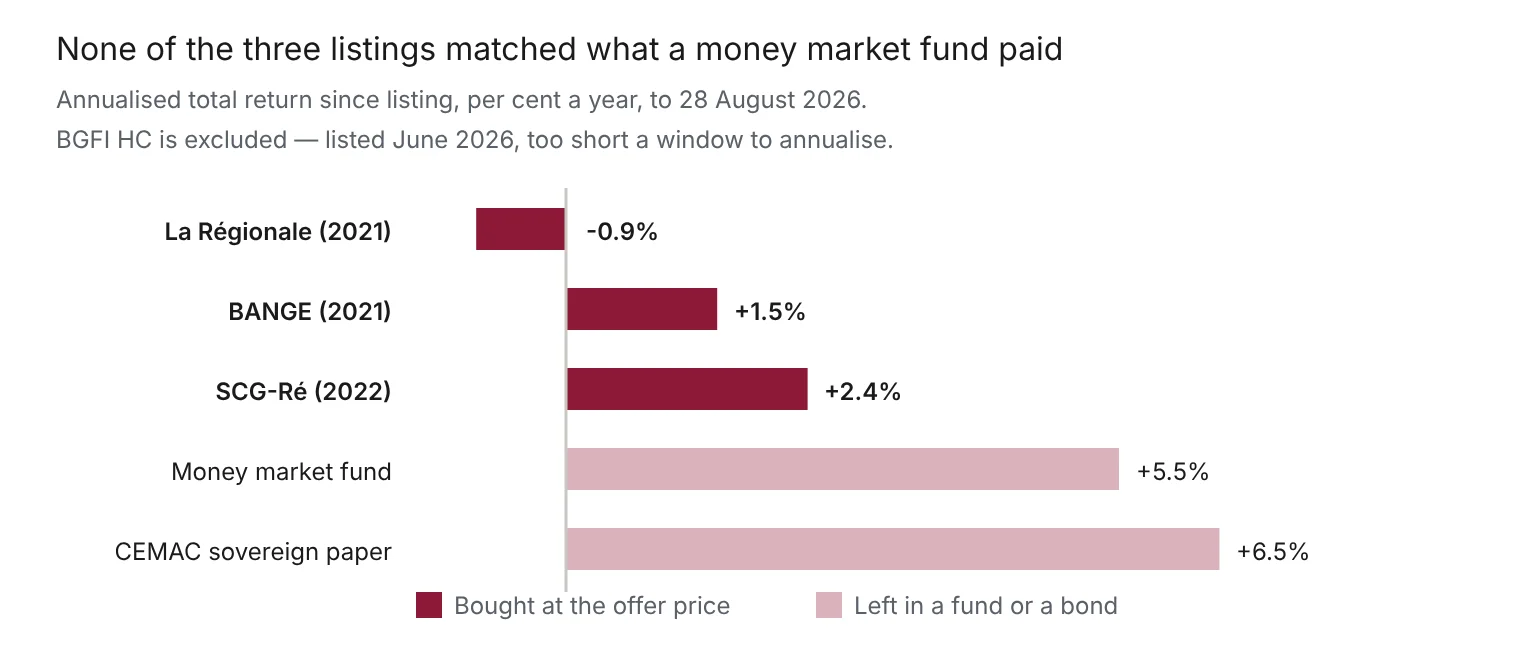
An investor who subscribed to La Régionale in 2021 has lost money in nominal terms before inflation. One who bought SCG-Ré in 2022 has the same price four years later and two dividends. The same money left in a money market fund — no prospectus, no lock-up, no credit analysis — earned around 5.5% a year.
The two that were done properly
SOCAPALM, 2009. The palm oil group came to market at roughly eight times its 2008 earnings. Nine years later, after a three-for-one split and 35% profit growth, it was still trading at eight to nine times — meaning shareholders had been paid by the business rather than by a change in sentiment. The re-rating came much later; the stock trades at 21.5 times today. These 2009 figures come from a secondary reconstruction rather than a document we hold, so treat them as indicative, but the shape of the record is clear enough.
BGFI Holding, 2026. The group applied a multiple of ten to consolidated profit of 122 billion, then tested the answer against thirteen listed West African banks trading at an average of 8.2 times earnings. Two genuinely different methods, agreeing within 2%. More telling: BGFI had bought Société Générale Congo in 2023 at about thirteen times earnings, and chose to price its own listing below the multiple it had just paid in a real transaction. It listed at 80,000 and traded at 90,000 in August, on a 14.7% return on equity.
It listed in June 2026, so there is not yet a long-run record to judge. What can be judged is the method, and the method was anchored to money the group had actually earned.
What to take from this
For anyone thinking of subscribing to the next one, the single most useful calculation takes two minutes. Divide the offer price by book value per share, multiply by what you think capital costs in this region, and you have the return on equity the company must deliver for you to break even. Then look at what it earns now. If the gap is wide, you are being asked to buy a forecast, and this study is a record of how those forecasts have gone.
There is a word owed to the arrangers as well. An offer priced at the top of what the market will bear raises the most capital on the day, and that is a real and legitimate objective for an issuer. But it is a one-time gain, and the bill arrives later — in a share price that goes nowhere for five years, in institutions that will not look at the next deal, in a secondary market where seven thousand shares can be offered and one changes hands.
A market needs people who bought early to have done well. On the BVMAC, for four of the last six listings, they did not.