
A fund worth considering: FCP L'ACM Performance
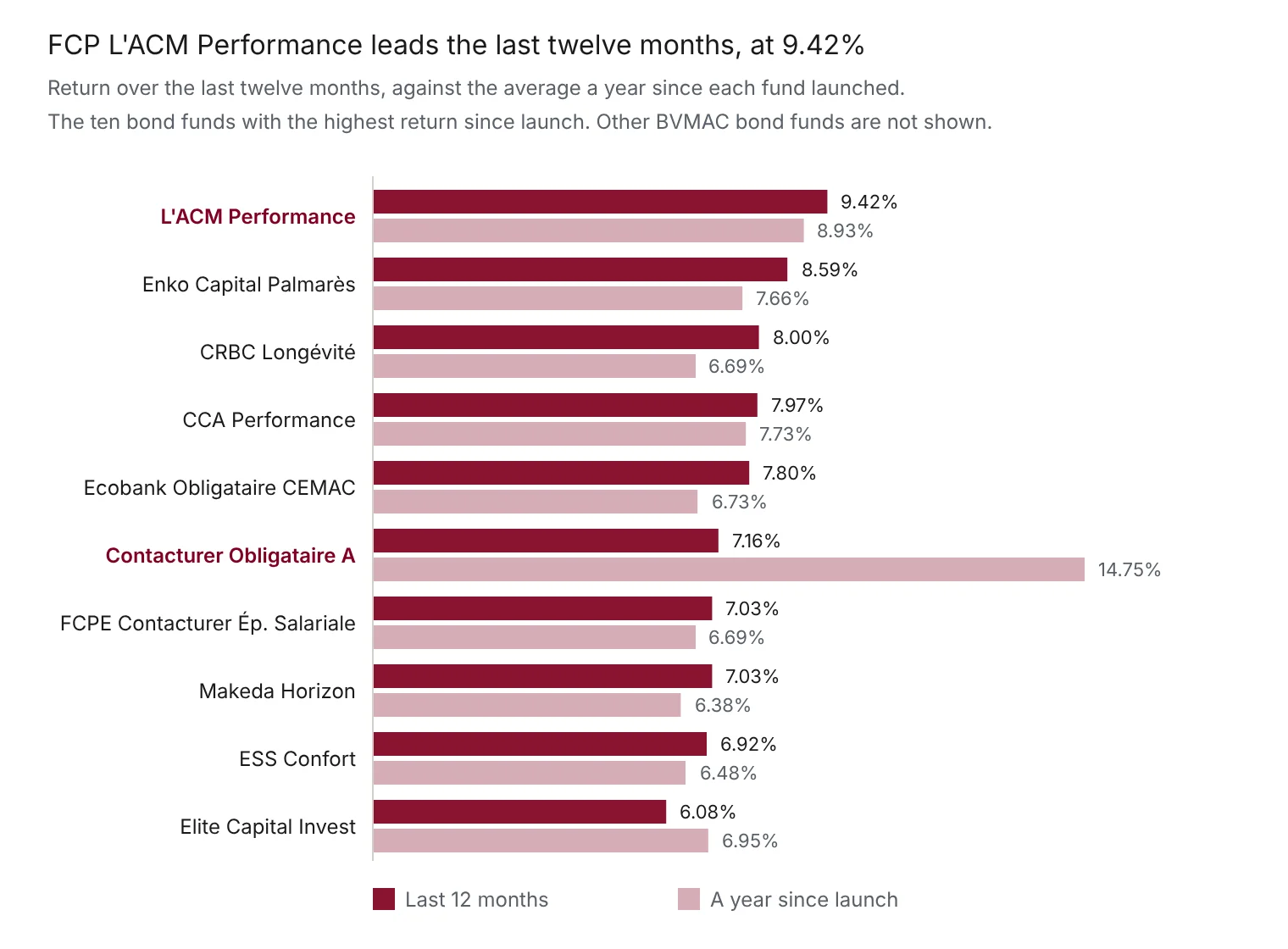
Over four years, FCP L'ACM Performance has returned 8.93% a year. That puts it second on the list, behind one much younger fund.
What makes it the one to look at is the recent record. Over the last twelve months it returned 9.42%, the highest of any fund here. Since January it has returned 8.37%, again the highest.
Most funds on this list have had a good twelve months — it has been a kind period for bonds, and eight of the ten did better over the last year than their own long-run average. L'ACM Performance is ahead of all of them now, and it was already ahead of eight of them before. That combination is what we are paying attention to.
One to watch: FCP Contacturer Obligataire
At the top of the table sits FCP Contacturer Obligataire, at 14.75% a year since launch. That is far above everything else, and it is worth looking at closely before taking it at face value.
The fund is 1.1 years old. Over the last twelve months it returned 7.16% — a decent figure, but below L'ACM Performance and below five other funds here.
Both numbers are correct, and they fit together. The 14.75% is an average across the fund's whole life, and that life is only a few weeks longer than twelve months. For the average to sit that far above the last twelve months, those few extra weeks must have been very strong.
A burst just after launch is common and is not a mark against the manager. It does mean the 14.75% tells you more about the fund's first weeks than about how it earns money month to month. Another year will show which.
What a bond fund is doing
Borrowers in our region raise money in two ways. Short — thirteen to fifty-two weeks, the Bons du Trésor Assimilables, or BTA. And long — two to ten years or more, the Obligations du Trésor Assimilables, or OTA, alongside bonds issued by companies.
A money market fund holds the short paper. A bond fund holds the long paper. Whoever waits longer to be repaid is paid more for waiting, and that is the entire reason a bond fund earns around 8% a year while a money market fund earns around 5.5%.
You buy units, the manager collects the interest, and your units are worth more over time.
What three extra points do
Three percentage points sounds small. Across a working life it is not.
Put 100,000 francs aside every month for twenty-five years. You will have paid in 30 million francs of your own money.
In a money market fund at 5.5%, that becomes about 64 million francs. In a bond fund at 8%, it becomes about 95 million.
Same savings, same discipline, same twenty-five years. The 31 million francs between them is what the extra three points did while you got on with your life.
And 95 million francs, still earning 8%, pays about 630,000 francs a month without touching the capital. That is the point where working becomes something you choose rather than something you must do.
How risky is this?
Lower than shares, and not zero.
A bond fund does not depend on a company making a profit. It depends on governments and large borrowers paying interest they have promised, which they generally do.
The real risk is timing. If interest rates rise, the bonds the fund already holds pay less than new ones, so they are worth less, and the fund's value can fall for a while. Hold on, and those bonds reach maturity and repay in full. Sell during that stretch, and you take the loss.
So the rule is about time, not nerve. Money you may need in the next two or three years does not belong here — that is what a money market fund is for. Money you can leave for five, ten or twenty years belongs here, and the longer you leave it, the less any single bad year matters.
The whole list
Fund | Age | Year to date | Last 12 months | A year since launch |
FCP Contacturer Obligataire – Parts A | 1.1 yrs | 6.30% | 7.16% | 14.75% |
FCP L'ACM Performance | 4.0 yrs | 8.37% | 9.42% | 8.93% |
FCP CCA Performance | 3.8 yrs | 6.86% | 7.97% | 7.73% |
FCP Enko Capital Palmarès | 3.9 yrs | 7.17% | 8.59% | 7.66% |
FCP Elite Capital Invest | 3.9 yrs | 4.72% | 6.08% | 6.95% |
FCP Ecobank Obligataire CEMAC | 6.3 yrs | 6.38% | 7.80% | 6.73% |
FCP CRBC Longévité | 4.0 yrs | 6.10% | 8.00% | 6.69% |
FCPE Contacturer Épargne Salariale | 1.1 yrs | 5.98% | 7.03% | 6.69% |
FCP ESS Confort | 4.3 yrs | 5.93% | 6.92% | 6.48% |
FCP Makeda Horizon | 3.5 yrs | 6.01% | 7.03% | 6.38% |
This is the top ten by return since launch. There are other bond funds listed on BVMAC that do not appear here, and a fund outside this table is not necessarily a weaker fund — it may simply be younger, or hold different paper.
Before you move any money
These figures come from net asset values published in the BVMAC bulletin, dated between 16 and 30 October 2026, so the funds are not all measured to the same day. Ask the management company for the two things the table cannot show: the entry and exit fees, and the minimum needed to open an account.
NB: Ranking based on NAV performance (excluding distributions).