
A fund worth considering: FCP ESS Trésor Privilège
Over 4.3 years, FCP ESS Trésor Privilège has returned 5.79% a year, the best lifetime figure on the BVMAC list. Over the last twelve months it returned 4.92%, a little below its own average — about what you would expect while rates ease.
What matters as much as the number is how it was earned. The fund has grown at close to the same speed every year since it started, without big jumps in either direction. For this kind of fund, that steadiness is the point.
Two others worth watching
FCP AB Cash has the second-best lifetime record, 5.72% a year over 5.2 years. But one reporting period this year shows its published value rising around 5% within a few days.
Interest alone would not produce a move that size — at 5 to 6% a year, a fund needs most of a year to accumulate 5%. There are ordinary explanations: a stale valuation caught up in one print, a provision written back, a change in method, none of them a reason to stay away. We would want to know which of them it was before putting money in.
FCP L'ACM Kimia raises a different question. It returned 5.97% over twelve months, the strongest of any established fund here, with four years behind it. But across its whole life it has averaged 5.07%, which puts it fourth. So last year was well above its own normal, and from outside we cannot tell whether the fund is being run differently now or simply had a good year.
Where your money goes
A money market fund pools money from many people. You buy units; a manager lends the pool out, mostly to governments, and collects the interest, so your units are worth a little more each day.
Governments here borrow in two forms. A BTA (Bon du Trésor Assimilable) runs thirteen, twenty-six or fifty-two weeks. An OTA (Obligation du Trésor Assimilable) runs two years or more and pays more, since you go without your money for longer. A money market fund holds mostly the short ones, a bond fund the long ones — most of the difference between them, and also why you can leave when you like.
Because those loans are short, money is always coming back into the fund — something matures every few weeks. So when you ask for your money, the manager usually has cash ready and does not have to sell anything in a hurry. That is why you can take your money out when you want it.
Against a fixed deposit, and against a savings account
The familiar alternative is the dépôt à terme: money locked with a bank at a fixed rate.
| Fixed deposit | Money market fund |
Getting your money back | Locked until the term ends; break it early and you lose the interest | A few days, no penalty |
The rate | Fixed on the day you sign | Moves with the market |
Who you are lending to | One bank | Several governments and banks |
If rates go up | You stay on the old, lower rate | Your return follows them up |
If rates go down | You keep the old, higher rate | Your return drifts down |
Minimum to start | Often large | Often modest |
The deposit wins one row outright — if you expect rates to fall, locking today's rate is the better trade. But the first row usually decides it.
For most readers the more useful comparison is the account the money already sits in. Savings accounts here commonly pay 2 to 3% a year, less after charges, while prices rise 2 to 4%. The balance never falls, so it feels safe; what falls is what it buys. Two million francs put aside for a wedding eighteen months away grows to about 2,076,000 in a savings account at 2.5%, and about 2,167,000 in a money market fund at 5.5%.
What it is for, and what fees do to it
This suits money with a date on it: a wedding in six months, a car in eighteen, school fees in September, an emergency fund that must be whole when needed.
Before comparing returns, ask for the fee schedule. An entry fee (droits d'entrée) comes out on the way in, an exit fee (droits de sortie) on the way out, and neither shows in any figure above. On short holdings they dominate: 2,000,000 francs in a fund earning 5.5% earns about 54,000 francs over six months — a 2% entry fee takes 40,000 of that on day one.
The whole list
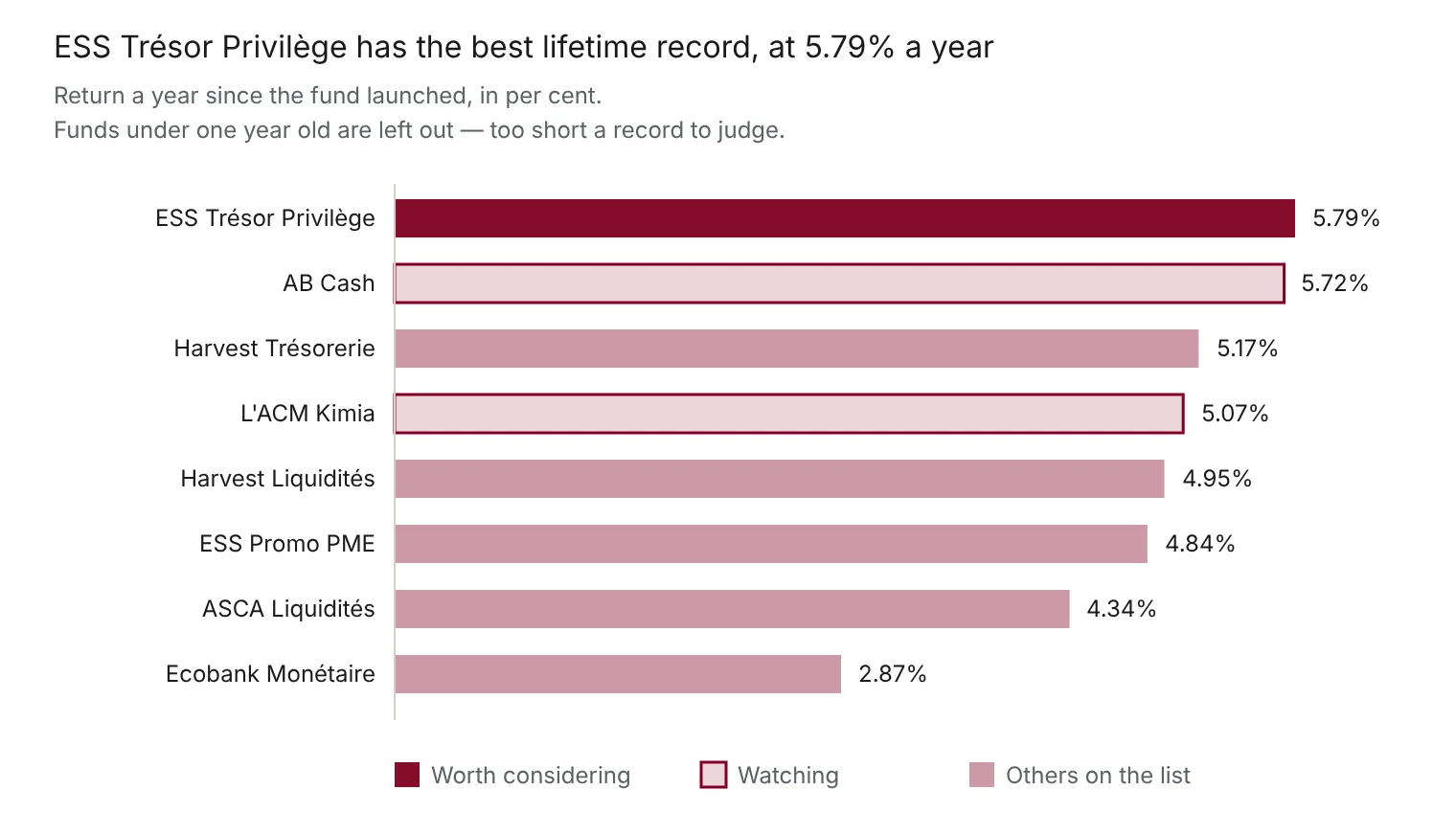
Fund | Running | Last 12 months | A year since launch |
FCP ESS Trésor Privilège | 4.3 yrs | 4.92% | 5.79% |
FCP AB Cash | 5.2 yrs | 3.96% | 5.72% |
FCP Harvest Trésorerie | 7.0 yrs | 4.30% | 5.17% |
FCP L'ACM Kimia | 4.0 yrs | 5.97% | 5.07% |
FCP Harvest Liquidités | 5.1 yrs | 3.71% | 4.95% |
FCP ESS Promo PME | 4.3 yrs | 3.81% | 4.84% |
FCP ASCA Liquidités | 9.7 yrs | 4.32% | 4.34% |
FCP Ecobank Monétaire CEMAC | 6.4 yrs | 5.90% | 2.87% |
FCP CCA Invest | 0.5 yrs | — | too new |
FCP Ecobank Transformation | 0.6 yrs | — | too new |
FCP Enko Capital Trésorerie | 0.5 yrs | — | too new |
Three have run about six months, too short to judge. Rates rise and fall, and a six-month-old fund has seen one kind of weather — in good weather, skill and luck look alike.
Before you move any money
These figures come from the BVMAC bulletin to 30 October 2026, and they describe what has already happened. One thing the table cannot show you is the minimum. Some of these funds are built for institutions, and the amount you need to open an account can be far above what an ordinary saver has to put in.
NB: Ranking based on NAV performance (excluding distributions).