
Warren Buffett's real secret
Warren Buffett is the most famous investor alive. He is worth around $141 billion.
He bought his first shares as a boy and never stopped. That one detail explains more than anything else about him.
Here is the part most people never hear. About 95% of his money arrived after his 65th birthday. On the day he turned 65, his stake in his company was worth around $12 billion. The other nine-tenths came afterwards.
He was not a better investor at 80 than he was at 40. He was already excellent at 40. What he had by 80 was time.
He also did not begin with a fortune. He began with small amounts, as a child, and simply kept going for more than eighty years. The size of his first investment is not why he is rich. The date of it is.
Two people, fifteen years apart
Take two people.
Person A starts at 25. She does not earn much, so she puts away 30,000 francs a month. She keeps going until she is 65.
Person B waits. He wants to be settled first. By 40 he is earning well, so he puts away 50,000 francs a month — far more than Person A ever manages. He also keeps going until 65.
Over their lifetimes, Person A puts in 14.4 million francs. Person B puts in 15 million. Person B saves 600,000 francs more of his own money than Person A does.
If both earn 8.5% a year, this is where they land at 65.
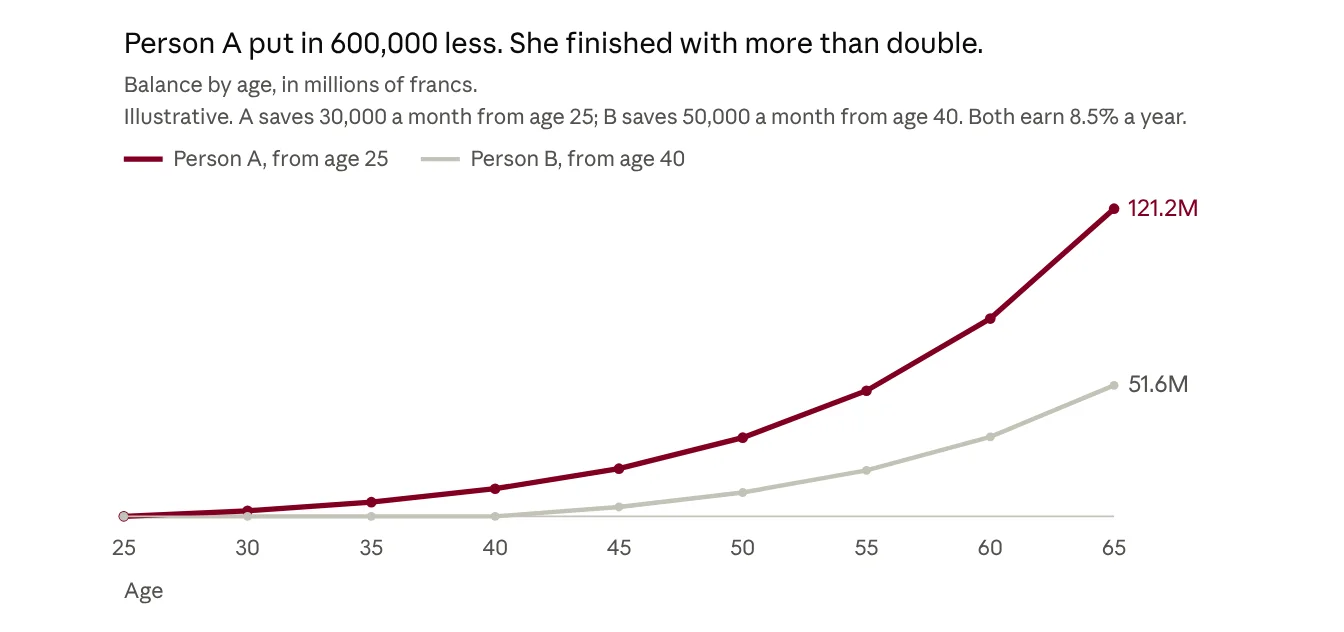
Person A finishes with about 121 million francs. Person B finishes with about 51 million.
Person A has more than twice as much — on less of her own money.
Where that money came from
Now look closely at Person A. She put in 14.4 million francs. She finished with 121 million.
Nobody gave her the other 107 million. Her money earned it — and then what it earned went on to earn more, and so did that.
That is all compound interest is. Your returns start producing returns of their own, and they never stop.
You can see it happen in her account. In the early years, nearly everything in there is money she put in herself. Around age 40 it flips: more than half of her balance is now money her money has made. By 65, she has contributed 14.4 million and her money has produced 107 million.
Person B's money did exactly the same thing. It simply had fifteen fewer years to do it.
Those fifteen years were not worth 600,000 francs. They were worth about 70 million.
Why the beginning feels like nothing
Look at Person A's line again. For the first fifteen years it barely lifts off the ground.
By 35 she has saved every month for ten years. She has put in 3.6 million francs and has about 5.6 million. Ten years of discipline, and her money has made her two million. It is very easy to look at that and decide it was not worth the trouble.
This is where almost everybody stops.
Now look at her last ten years. Between 55 and 65 her balance climbs from 49.5 million to 121 million. In that single decade her money makes about 71 million francs — roughly five times everything she contributed in her entire life.
She is not trying harder at 60. She is putting in the same 30,000 francs a month she always did. There is simply far more money working for her now, so each year adds more than the year before it.
The boring part comes first and the spectacular part comes last. You cannot have the second without sitting through the first.
So what do you actually do
There is a lot you cannot control. Not what the market does next year, not interest rates, not the price of any share. You can control when you start, and that turns out to be the lever that matters most.
The amount is not the point. This is where people talk themselves out of it. If you earn 70,000 francs a month, start with 10,000. If that is too much, start with 5,000. What matters is that some percentage of what you earn goes somewhere it can grow, every month, beginning now. You will raise the amount later, as you earn more. What you can never do later is get the years back.
One thing to be clear about: none of this happens in an ordinary current account. Money sitting there earns close to nothing while prices rise around it, so it quietly loses value every year.
It has to go somewhere that pays you. In our markets that usually means funds that invest in government bonds, or funds that invest in the shares of listed companies. You buy a small share of the fund, the fund holds the bonds or the shares, and what those pay flows back to you. Many of them accept modest amounts, which is exactly what you need when you are starting small. We will go through the options properly in the posts that follow.
If you are young, this is the largest financial advantage you will ever hold. It is completely invisible, it costs you nothing, and it expires quietly, one year at a time.
If you are not young, start anyway. Person B still finished with 51 million francs. The worst outcome is not starting late. It is spending another five years deciding.
The best day to start was years ago. The second best is this month.