

Two men, two endings
In 2003, Mike Tyson walked into a bankruptcy court owing $38 million. He had earned an estimated $400 million in the boxing ring.
The court papers showed where it had gone. Around $4.5 million on cars and motorcycles. Around $3.4 million on clothes and jewellery. Another $7.8 million written down as “personal expenses.”
Tyson never had an income problem. He had a keeping problem. No salary on earth can outrun spending that grows to match it.
Now the other man. Ronald Read pumped fuel at a filling station in a small American town, then swept floors in a shop. He never earned a big salary in his life.
When he died in 2014 he left about $8 million. He gave $4.8 million to his local hospital and $1.2 million to his local library. Almost nobody in the town had known he had anything.
He did one thing, over and over. He kept a part of every pay packet, used it to buy shares in companies he understood, and held them for decades.
Read earned perhaps a thousand times less than Tyson. Read died wealthy. Tyson went to court. The difference was not what they earned. It was what they kept, and what they did with it.
Wealth is not what you earn. It is what you do not spend.
That is harder to see than it sounds, because the money you can see — the car, the clothes, the big house — is money somebody no longer has. The money you cannot see is the money still working for them.
Why a bigger salary rarely helps
The most common plan in personal finance is to start saving once you earn more. It almost never works.
Spending grows with income, and it usually grows just as fast. The raise arrives. Within a few months it has gone into a better flat, a car that needed replacing, a school you had been hoping for. Each choice made sense on its own. Together they swallowed the whole raise.
This is called lifestyle inflation, and it is what happened to Tyson's $400 million.
So here is the test. If you cannot keep 10% of what you earn today, you will not keep 10% when the number gets bigger. The zeros change. The habit does not.
The way out is not to earn more and hope. It is to know three numbers.
Number one: what you actually earn
Your salary is not your income.
Income is everything that comes in. Salary, a small business on the side, commissions, rent from a room, work you do outside your job. Add all of it together.
Use three months, not one. Money rarely arrives evenly — a good month follows a weak one, commissions come in bunches, trade has its season. Add up three months of everything that came in, then divide by three.
Leave out what will not happen again. A piece of land you sold, a gift at a wedding, money you are holding for someone else. Counting those will make your picture look better than it really is.
Number two: what you must spend
Split your spending into two groups.
What you must pay. Rent, food, transport, electricity and water, school fees, insurance, loan repayments, and the regular support you send to family. If it leaves every month without you deciding, it belongs here.
What you choose to pay. Everything else. The outing, the new phone, the clothes.
Two tips. Write down what you actually spent, not what you think you spend — almost everyone guesses too low. And for anything paid in one big lump, like yearly rent or termly school fees, divide it across the months it covers. Otherwise you feel fine for eleven months and panic in the twelfth.
Number three: what you keep
Take the first number, subtract the second, and turn the answer into a percentage of what you earn.
If you earn 400,000 a month and 340,000 must go out, you keep 60,000. That is 15%.
That percentage is the number to watch. Not the amount — the percentage. It is the one thing in your financial life that stays meaningful whether you earn a little or a lot.
How what you keep makes you rich
Knowing the three numbers does not make anyone rich. What you do with the third one does.
Money kept in a drawer or a current account just sits there, and prices rise every year, so it slowly buys less than it used to.
To build wealth, the money you keep has to buy something that pays you back. Shares in a company pay dividends. Government bonds pay interest. A rented room pays rent.
Here is the part that does the real work. When those payments arrive, you use them to buy more of the same thing. Now you own a little more, so next year pays you a little more, which buys more again.
That is compounding. For years it looks like almost nothing is happening. Then it stops looking like nothing.
Ronald Read did nothing cleverer than this. He bought, he reinvested what came back, and he waited about fifty years. The $8 million was not luck. It was a small percentage, repeated for a very long time.
And eventually something important happens. What your investments pay you in a year becomes enough to cover what you spend in a year. From that day, working is a choice rather than a requirement.
That is financial freedom, and the share you keep decides how long it takes to arrive.
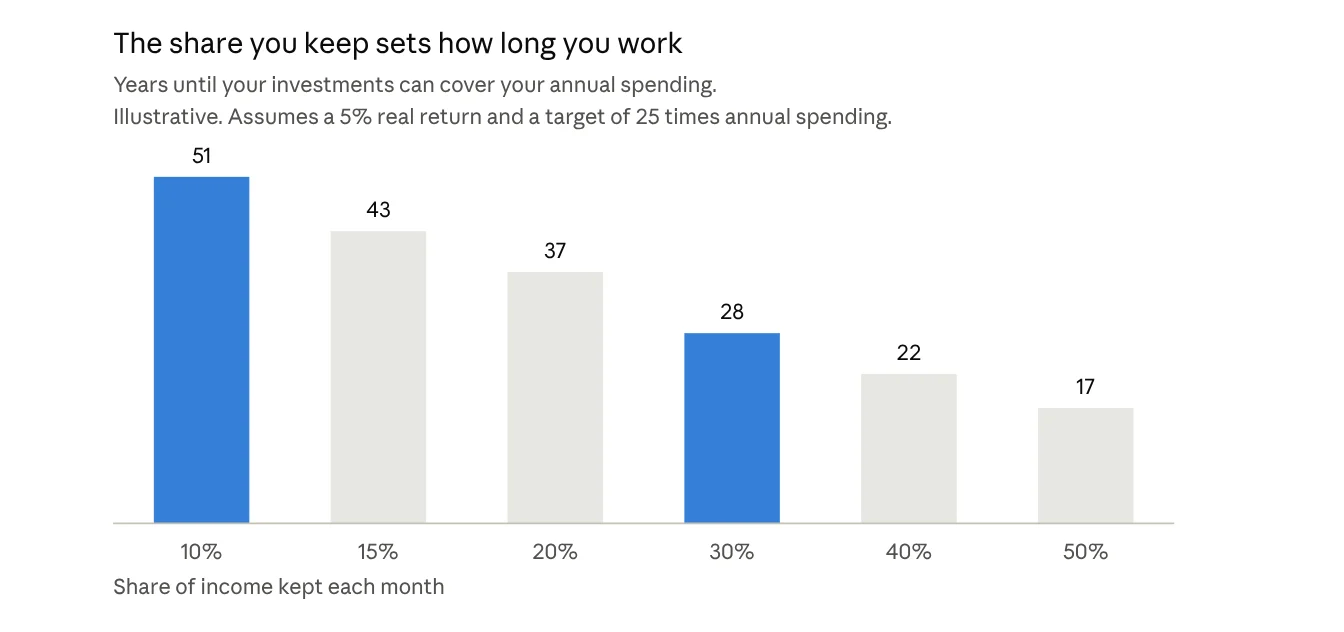
Someone keeping 10% of their income waits about half a century. Someone keeping 30% is there in under thirty years. Same job, same salary — a different share kept.
What these numbers decide
These three figures do more than describe your money. They quietly set the timing of decisions most people think of as personal:
• When you can move out of the family house, and into what kind of place
• Whether a car is something you own or something that owns you
• When you marry, and whether that timing is yours or somebody else's
• How many children, and how far apart
• Whether you can take a lower-paying job that leads somewhere better
Most people think that working out these numbers will limit those choices. It works the other way round. The numbers are already deciding, whether you look at them or not. Not knowing them does not set you free — it means circumstances choose for you.
Start tonight
1. Open three months of bank and mobile money statements.
2. Add up everything that came in. Add up everything that had to go out. Divide each total by three.
3. Subtract the second from the first, and write the answer as a percentage.
One page, less than an hour, no software. The first time, the number is usually uncomfortable. That is not a judgement on you — it is just the first honest look.
If the percentage is low, there are two ways to move it. Earning more is the slower one: a qualification, a better role, a skill you do not have yet. Cutting what you must pay is faster and harder, because those costs are made of promises, not just figures.
Then check it again next month, and the month after. You are not watching the amount. You are watching whether the percentage is rising — because that percentage, invested and left alone, is the thing that eventually buys back your time.